Bahruz Samadov's closing speech at Supreme Court
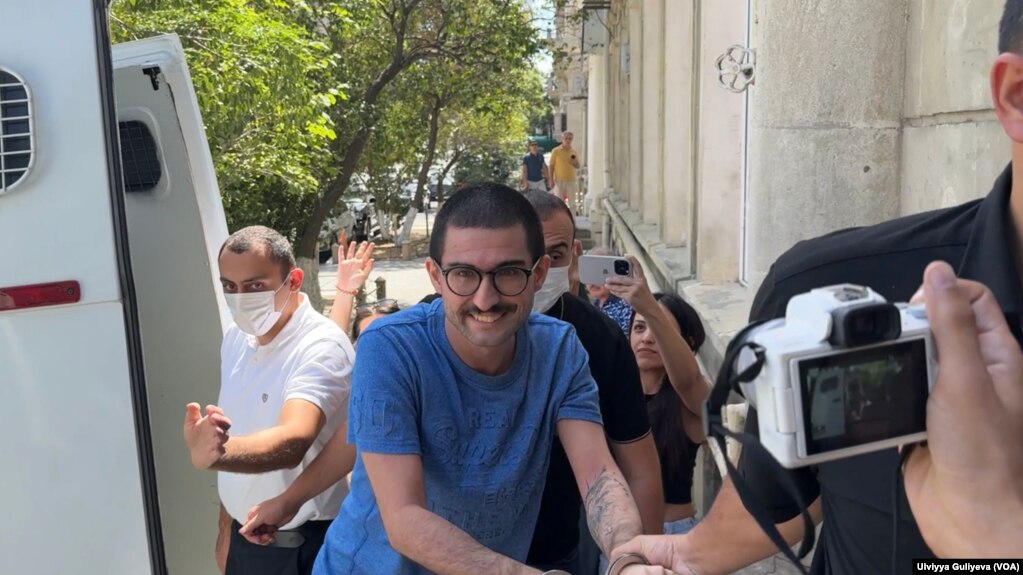
Before beginning my speech, I want to express my deep gratitude to the people who are here today, who came to support me. Their conscientiousness, their commitment to progressive values, is beyond doubt even in these heavy times we are living through. I am also grateful to my foreign supporters who saw my appeal and came to this courtroom. Seeing you gladdens me and lifts my spirits.
My speech will have the spirit of a lecture. As you know, I was a university lecturer; I gave talks at academic conferences. My arrest based on orders has deprived me of that. A court hearing is my opportunity to give a speech. I dedicate this speech, as we all know, to our departed friends — Bayram Mammadov, Mehman Galandarov, and Elbay Karimli.
Mehman Galandarov and Elbay Karimli were driven to suicide in prison. The cause of their deaths was the repression machine commissioned from the very top. My dear friend Bayram Mammadov, too, ended his own life because of the traumas he endured — a slander-based, unjust arrest, torture, and despair. I also express my deep gratitude to the parents, who suffer at least as much as the political prisoners themselves. And I remember with reverence Shamshad Agha's mother and Ali Karimli's father, who passed away this year while their children were in prison.
As you know, the World Urban Forum is being held in Baku these days. Azerbaijan cooperates with the UN. But does the Azerbaijani government pay any heed to international appeals? In 2025, UN experts criticized the long prison sentences handed down to me and to Igbal Abilov on charges of treason against the state, and called the equating of academic research and calls for peace with treason inadmissible. The statement said the UN had conveyed these concerns to the Azerbaijani side.
So where is the result? What just position of Azerbaijan can we even speak of, when there are hundreds of political prisoners in the country? Among them are dozens of journalists, politicians, and civil society researchers. The activity of the mass media and of civil society institutions has been brought fully under control and is regulated on the basis of draconian legislation. Independent and critical discourses in society have been suppressed entirely. International appeals are labeled biased. And the suffocating environment is being tightened further still. By hosting events of this kind, the Azerbaijani government aims to whitewash the authoritarian environment in the country.
"Blessed are the peacemakers," says the Gospel. I, too, am happy that I stand before you today as a peacemaker. Yes — I have been charged with treason against the state for being an advocate of the peace that Mr. President Donald Trump brought to the region. And I have been convicted, on orders, to a heavy prison sentence. As if that horror were not enough, after being held for two months in a punishment cell full of severe deprivations, I have now, for nearly four months, been held in the country's harshest closed-regime prison.
The reason a peace-minded researcher like me is here is the Azerbaijani state's particular cruelty toward me. The state's intolerance of the intellectual approach that is my product exceeds all limits. They hate me the way the fascists hated the Frankfurt School and left-wing intellectuals. Because I did not become one of those so-called researchers who draw a salary from the authoritarian regime, parrot its narratives, and have these days dressed themselves up in the garb of peacemakers. And I rejected the offers that were made to me.
Inspired by Antonio Gramsci, who gave up his life in a fascist dungeon, I practiced, as he put it, "optimism of the will together with pessimism of the intellect." And I became an academic-political activist. In January of this year, the world-renowned Slovenian philosopher Slavoj Žižek, who has deeply influenced my intellectual work, appealed to the head of state for my release. Expressing my gratitude to him from here, I want to make a digression drawing on his book “Freedom: A Disease Without a Cure”.
In every society, there are matters that must not be spoken about publicly. And yet every mature member of society knows them. Exactly like what is said in my academic and journalistic articles. For instance, by speaking openly about well-known intolerances and about dark moments in history, I was searching for an alternative to hegemonic statist-nationalism. I questioned that ideology. I called for inclusive peace. Even the officers of the SSS [State Security Service] admitted that those articles were grounded in fact.
Although Deng Xiaoping, the former secretary of the Chinese Communist Party, formally resigned in the last years of his life, everyone knew that he continued to run the party. One of the CCP's apparatchiks, for calling Deng Xiaoping China's de facto leader in an interview with a foreign journalist, was accused of divulging a state secret and punished. Which means a state secret is not always something known only to a few — it can also be a secret that everyone knows and keeps silent about.
When that is the case, the law itself becomes unknown to its own subjects. Intellectuals who speak and write the truth are accused of divulging state secrets. And despotism shows them its power. My own situation shows how this repeats itself even inside the prison. Obstructing a search, making noise, demanding a radio... On accusations like these — both laughable and unconscionable — I was sent from Penitentiary Facility No. 11 to a closed-regime prison.
While I was being held in a punishment cell on unlawful grounds, the head of Penitentiary Facility No. 11, Shakir Ganiyev — a man notorious for his cruelty and bribe-taking — told me, with Kafkaesque politeness, one part of the truth: "The decision to put you in the punishment cell was made not by me, but by the SSS."
After the Baku Court of Appeal upheld the verdict — ordered from the top — on 5 February 2026, I began a hunger strike in the Baku Investigative Detention Facility. Despite my formal written request to its head, Elnur Ismayilov, I was not transferred to the medical-sanitary unit. And on 7 February, under the use of force and threats, I was taken from the Baku Investigative Detention Facility to the Umbaki Penitentiary Complex. There, too, I continued the hunger strike.
Later I received word that the Republic of Armenia had issued an official statement concerning me. That statement had been one of the demands of the hunger strike I had undertaken earlier. Taking this into account, I ended the hunger strike. And so, for nearly four months now, I have been held under every kind of deprivation in a closed-regime prison.
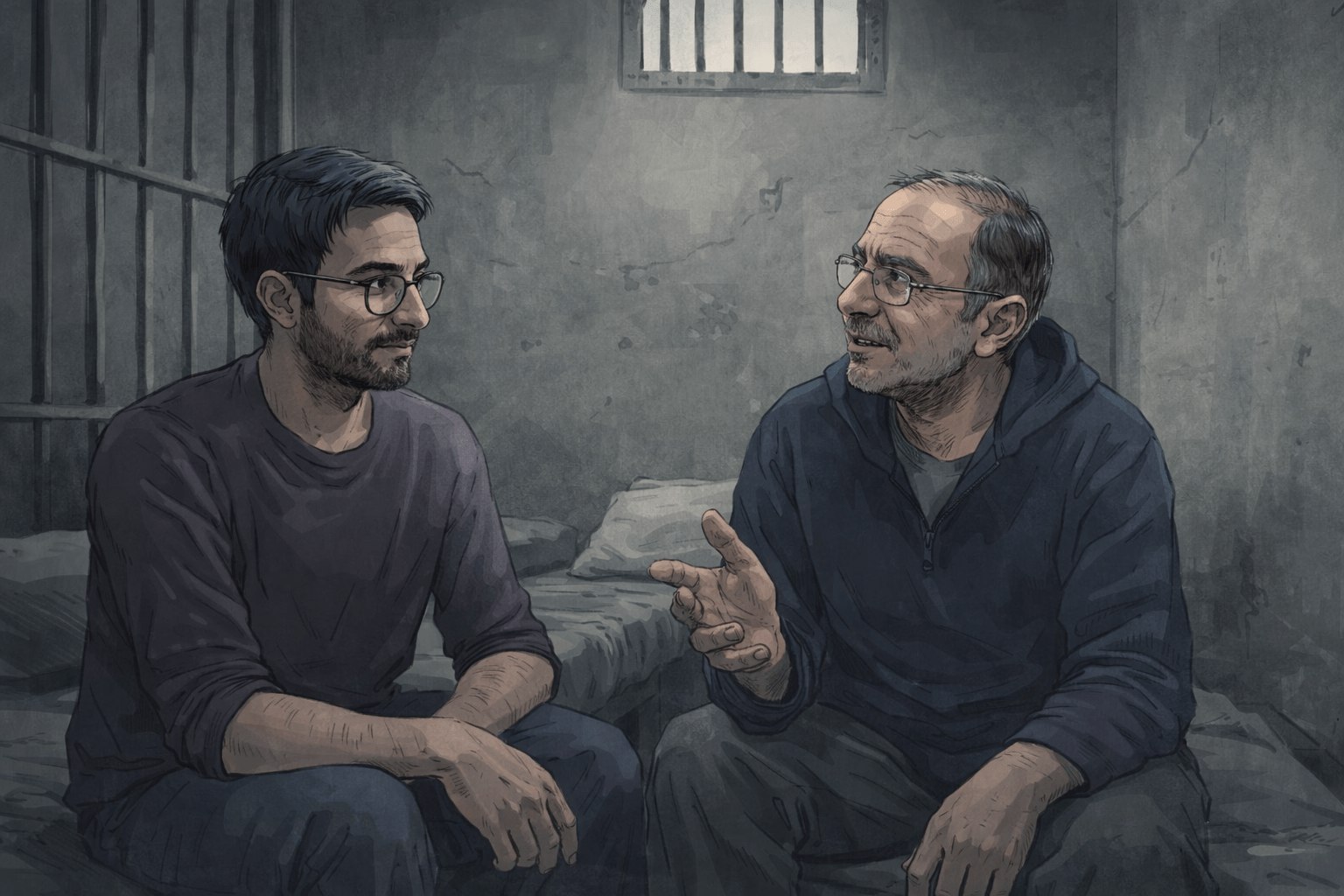
The international support I received and my resolute stance drove the authorities into such hysteria that they shamelessly resorted to this method of torture. I am now held in a small cell six paces long and four paces wide, equipped with a single radio as my only means of receiving information. I have just one hour a day to get sunlight and fresh air. This continuous torture is having a sharply negative effect on both my eyes and my psychological state.
If this is not torture, then what is it? Today marks 21 months since my arrest. For 21 months I have been held in closed conditions. For 21 months I have seen no sun, no flowers. Without retreating a single step from my peace-minded position, I say: flowers are superior to bullets. Holding me under a closed regime is part of a policy of terror directed against my person, and its purpose is to render me unfit for future academic and political activity.
Alongside the enmity directed at me from the highest level, I am also witnessing a beautiful example of solidarity at the international and local levels. As Dr. Martin Luther King said: "Injustice anywhere is a threat to justice everywhere."
Let us look at Resolution 1900 of the Parliamentary Assembly of the Council of Europe, adopted in 2012, on the definition of a political prisoner. My imprisonment and the fabricated verdict against me meet two criteria of the resolution's third paragraph:
A) My detention violates fundamental rights under the European Convention on Human Rights — in particular my right to defend myself, my right to a fair trial, and my right to liberty and security.
E) Political motive was the driving basis of an unjust criminal case. Mutatis mutandis, the policy of repression pursued against me can also be assessed on the basis of the four criteria and the assessment in the case that Giyas Ibrahimov and the late Bayram Mammadov brought against Azerbaijan — and won — at the European Court of Human Rights:
1. The prisoner's public profile. Before my arrest, I was known in the region as a participant, expert, and academic of the democratic, inclusive peace discourse. I have been a political activist in the country since 2013. Since 2019, I have been pursuing doctoral studies in political science in Prague. In my research, I clearly demonstrated that the politics of hatred and militarism is an inseparable ideological pillar of despotism. My arrest cut my academic work short and has prevented me from completing my dissertation. My last, unfinished study was meant to show the historically positive moments between the Azerbaijani and Armenian communities.
2. The sequence of events. On 21 August 2024, several days after my arrest, I was subjected to severe torture. Despite the marks of torture on my body, no medical examination was carried out. In those same days and afterward, unconscionable slanders against me and materials belonging to the investigation were published in pro-government media. Nor did the prosecutor's office conduct any inquiry into the materials broadcast on Baku TV.
3. Neither the sham preliminary investigation nor the orchestrated court could produce anything to prove the absurd charges of passing state secrets and espionage. In what way did my academic activity create a threat to state security? What state secrets was I privy to, that I could pass them on to society — let alone to Armenians? According to one piece of "evidence," I committed treason against the state by recommending Gunel Movlud's novel “Düşərgə” ("The Camp") to an Armenian colleague.
4. The conduct of the judiciary during the trial likewise proves that my imprisonment was ordered on account of my political activity. The court's examination reckoned neither with witness testimony nor with the arguments of the defense. And I was given a heavy sentence of 15 years.
But as you can see, the authorities did not stop even there. If the Azerbaijani government is not merely imitating the Washington accord — if the government is truly faithful to the peace and the peace agenda brought by Mr. Donald Trump — then what is the reason for this cruelty toward a peace activist?
In closing, I appeal to all people of conscience in the world, to international organizations, and to the leaders and intellectuals of the democratic world, whatever their political views: do not forget Azerbaijan's political prisoners. Stand in solidarity with us, and do not remain indifferent to human rights violations, torture, and countless unlawful arrests. I express my deep gratitude to my grandmother, who supports me, to my dear friends, to progressive academics and activists, to media organizations, and to human rights defenders.
Amnesty for political prisoners! Long live peace and democracy!
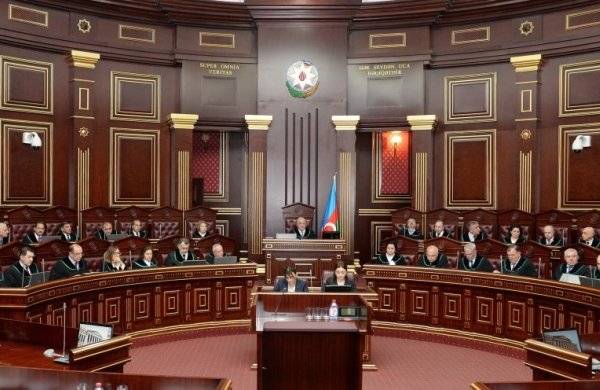
Bahruz Samadov. 21 May, 2026. Closing speech at the Azerbaijan Supreme Court.